Dr. Wanjala’s Practical Guide to Producing High-Quality Research Papers
- Agnes Kiconco
- /
- October 02, 2026
- 305
By Hattie Wright
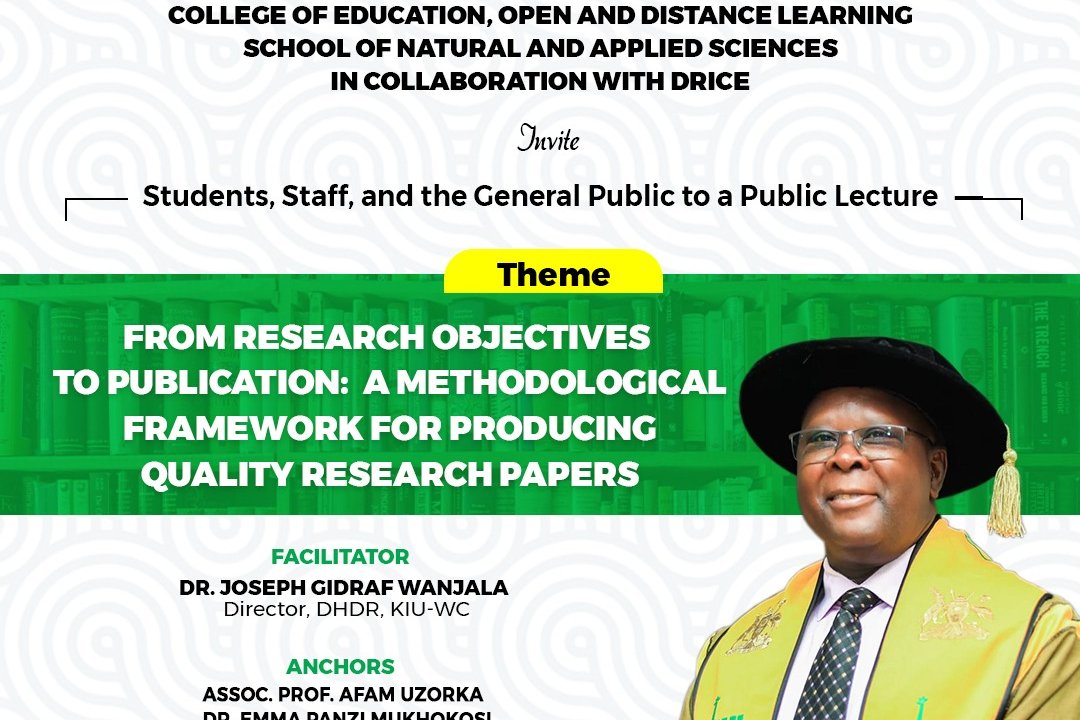
KIU, Main Campus - On Friday, October 2nd, 2026, Kampala International University (KIU), in collaboration with the College of Education, Open and Distance Learning (CEODL), the School of Natural and Applied Sciences, and the Directorate of Research, Innovations, Consultancy and Extensions, held a virtual public lecture for early-career scholars and graduate students. It was held under the theme "From Research Objectives to Publication: A Methodological Framework for Producing High-Quality Research Papers."
Speaking at the lecture, Dr. Joseph Gidraf Wanjala, Principal of CEODL, stressed that the quality of a publication is decided long before submission, at the earliest stages of the research process. He named four weaknesses that commonly hold research back: unclear research objectives, poor alignment, methodological weaknesses, and inadequate reporting. Here is his framework, step by step.
Step 1: Start with a significant research problem
Every good study begins with a clearly identified problem that is significant and capable of generating meaningful inquiry. The problem is central to the whole process, and the objectives, theoretical framework, methodology, analysis, findings, and conclusions should all grow from it as one coherent structure. Dr. Wanjala described this as essential for research readiness.
Step 2: Write sharp objectives
Objectives are the "organising thread" of a study, because they turn the research problem into specific tasks that guide the investigation. Strong objectives clearly specify:
- the variables
- the population
- the location
- the measurable outcomes
- the analytical direction of the study
Step 3: Check your alignment
The research problem, objectives, research questions, methodology, findings, and conclusions must be closely connected. "When the problem, objectives, questions and findings point in different directions, the study becomes weak," Dr. Wanjala explained. He described alignment as a quality-checking tool that strengthens internal validity, transparency, and credibility.
Step 4: Strengthen your methodology
Dr. Wanjala outlined a methodology improvement model with five parts:
- select an appropriate research design
- determine the study population and sample size
- choose suitable research instruments
- ensure quality control
- apply appropriate data analysis methods
Step 5: Explain your methods fully
Inadequate explanation is another barrier to publication. Researchers should describe the research design, sampling procedures, data analysis, and ethical considerations in enough detail for readers to judge the reliability and credibility of the study. Missing detail reduces readers' confidence in the methodology.
Step 6: Present and interpret your findings
Present evidence clearly, using appropriate tables and other relevant approaches. Then go further: interpret the evidence, compare your findings with existing studies, and draw conclusions that rest on the evidence you generated. Weak academic writing can also obscure the focus of a study and damage its credibility.
Step 7: Build a literature review that does real work
"A literature review is not simply a collection of summaries but the analytical foundation that positions a study within wider scholarly debates," he said. Rather than listing authors and their findings, show the relationships and connections among existing studies. A strong review lays out what is already known, identifies the gaps, and shows how your research contributes to the wider body of scholarship.
Step 8: Run a readiness check before you submit
Dr. Wanjala introduced a quick diagnostic rubric covering the clarity of the research problem, the quality of objectives, the suitability of the methodology, evidence reporting, and discipline in drawing conclusions. He urged researchers to ask themselves three questions before presenting, submitting, or publishing:
- Do the findings directly address the research objectives?
- Does the evidence adequately answer the research problem?
- Are the conclusions fully supported by the findings?
- Many studies, he noted, run into difficulty at the approval stage because of weaknesses in exactly these areas.
The lecture underscored the importance of developing research with publication in mind from the outset. With clear objectives, strong alignment, sound methodology, effective reporting, and evidence-based conclusions, researchers can improve the quality, credibility, and relevance of their work.
The session also reaffirmed KIU's commitment to strengthening research capacity among early-career scholars and graduate students, and to promoting research that contributes meaningfully to academic knowledge, policy, professional practice, and societal development.