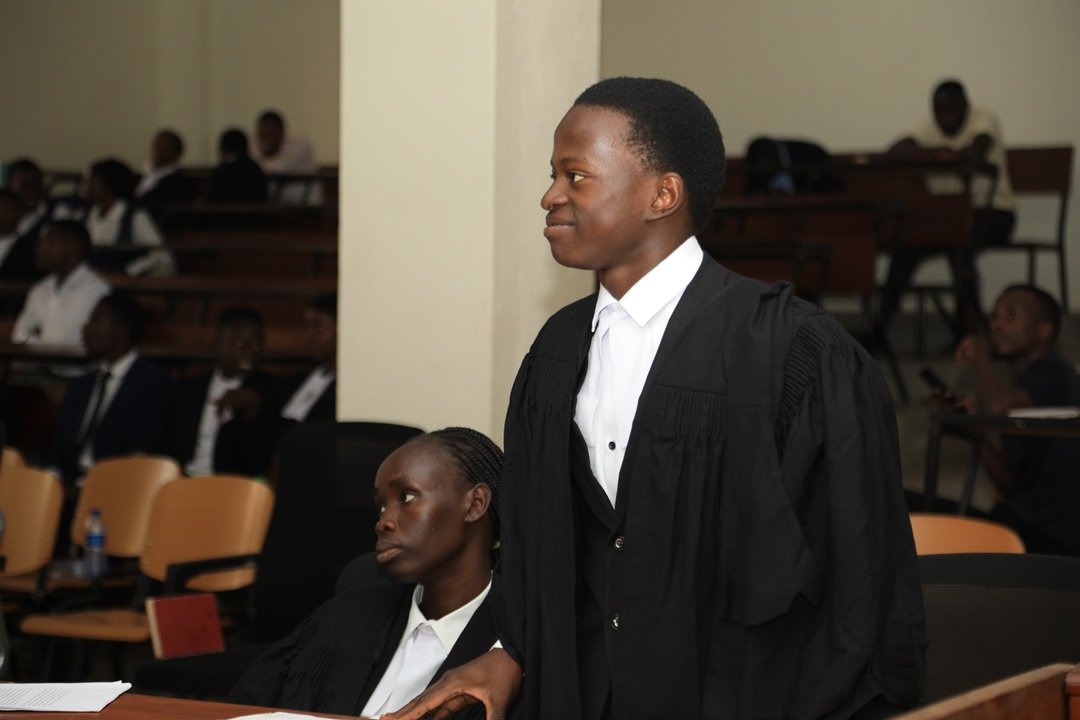
KIU Public Lecture Explores Why Courts Sometimes Decide Against Public Expectations
- Nakanwagi Annet
- /
- August 21, 2026
- 494

KIU, Western Campus - Kampala International University, Western Campus (KIU-WC) on Friday, August 21st, 2026, hosted a public lecture that challenged participants to look beyond public sentiment in understanding how courts arrive at decisions, particularly when those decisions appear to contradict what society expects.
Held at the Staff Common Room, the lecture organized by the Directorate of Research, Innovation, Consultancy and Extension (DRICE) in collaboration with the School of Law (SOL), KIU-WC, under the theme “When Law, Justice and Public Conscience Collide: Why Courts Sometimes Decide Against Public Expectations,” brought together university leaders, legal scholars, a judicial officer, students and members of the university community to examine some of the persistent misconceptions surrounding lawyers, courts and the administration of justice.

Welcoming participants, Prof. Patrick Aja Maduabuchi, Director, RICE, emphasized the value of public lectures in creating spaces where academic knowledge can engage with issues affecting society. He noted that such engagements enable the university to share its expertize while encouraging meaningful dialogue beyond the classroom.
Officially opening the lecture, Assoc. Prof. Eric Mabonga, Deputy Vice Chancellor, KIU-WC, commended DRICE and SOL for choosing a theme that speaks directly to the experiences and perceptions of ordinary members of the public. He observed that people who are unfamiliar with the legal profession can sometimes judge courts and judges based on whether a decision favours the side they sympathize with. “Sometimes as the public, we have sympathy for those being presented in court, and we condemn the courts and the judges themselves,” he said.
Assoc. Prof. Mabonga challenged SOL to take such conversations beyond the university so that communities can better understand the justice system and appreciate the knowledge and expertise housed at KIU.

Building on that foundation, Dr. Maria Umo Edet, Dean, SOL, KIU-WC, described the court as a “temple of justice” and explained the distinctive role lawyers play in helping courts arrive at decisions. “For us as lawyers, the law court is a temple of justice, where lawyers are referred to as ministers in the temple of justice,” she said.
Dr. Edet expressed appreciation to the organizers and the public lecturer for creating an opportunity to confront misconceptions about the legal profession, noting that the discussion would help participants develop a more informed understanding of the work of lawyers and courts.

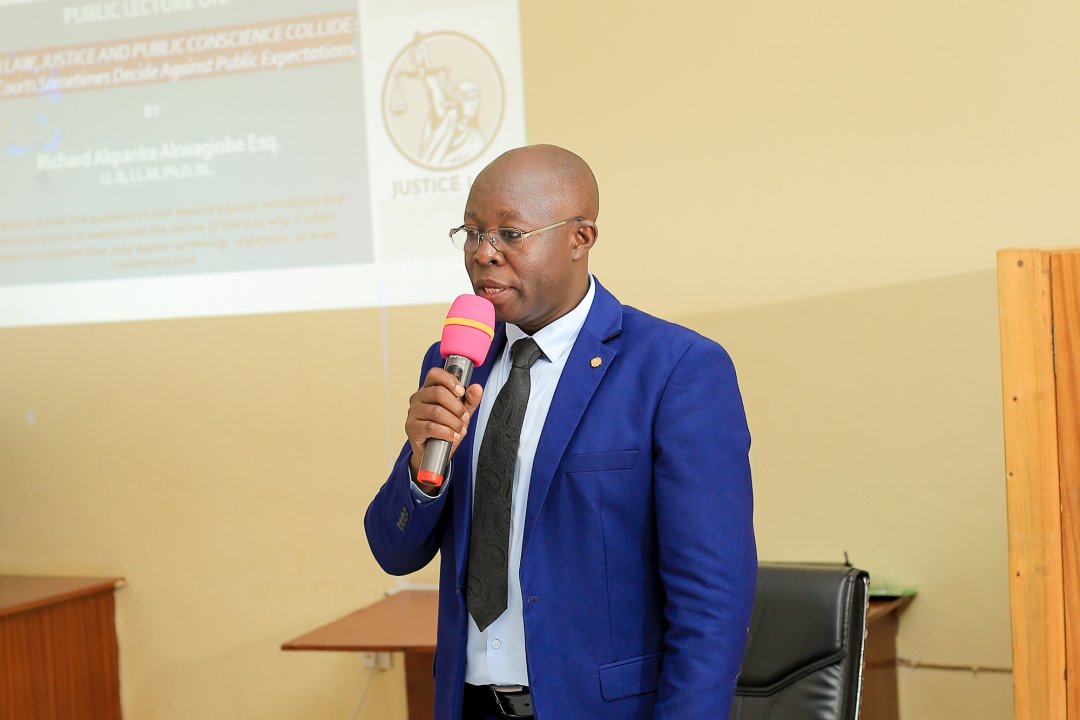
The task of unpacking those misconceptions then fell to the day’s public lecturer, Dr. Richard Akpanke Akwagiobe, Head, Department of Public and Comparative Law, KIU-WC, whose presentation examined the three central concepts in the theme—law, justice and public conscience—and the tensions that arise when they do not point in the same direction.
Dr. Akwagiobe began by confronting some of the most common perceptions about lawyers, courts and the judiciary: that “lawyers are liars,” that they manipulate facts, defend guilty people for money and can “turn black to white”; that courts do not deliver justice; and that justice is primarily available to the wealthy. He contrasted these negative perceptions with more positive views, including the long-held description of the judiciary as “the last hope of the common man” and the biblical portrayal of peacemakers as children of God.
He explained that even the seemingly straightforward concept of law is difficult to define exhaustively because legal systems, societies and philosophical approaches differ. Drawing on the natural law, positivist, realist, historical and sociological schools of thought, he demonstrated how each offers a different understanding of what constitutes law and what law should achieve. Regardless of the school of thought, he noted, law serves important functions, including maintaining public order, resolving disputes peacefully, regulating human behaviour, protecting freedoms and facilitating social and economic development.
The lecturer also drew a clear distinction between public conscience and justice, warning that popular opinion can sometimes demand punishment before an accused person has been given an opportunity to defend themselves. Turning to criminal justice, he explained the importance of actus reus and mens rea, the principle of legality, the presumption of innocence and the burden of proof. A person may be seen committing an act, he explained, but the law may require proof of the particular intention behind that act before criminal liability can be established. In criminal cases, the prosecution must therefore prove guilt beyond reasonable doubt.
“Any justice that does not give a person an opportunity to be heard, any justice where you, the accuser, become even the judge and the executioner, that justice is not warranted,” he cautioned.
Dr. Akwagiobe further explained why courts cannot simply rely on public discussions, media reports or what appears obvious to society. Courts must decide cases on admissible evidence, not speculation. He used examples involving hearsay, improperly obtained confessions and evidence that may appear convincing to the public but cannot legally be admitted in court. He also addressed the enduring question of why lawyers defend people accused of crimes, stressing that advocates defend the rights of accused persons, not their alleged actions.
His presentation concluded with a broader reflection on the tension between public expectations and judicial responsibility. “A decision may be unpopular, yet still be legally sound, constitutionally necessary and ultimately protective of the very freedom society cherishes,” he argued.

Responding to the presentation, His Worship Deogratious Tendo, Magistrate, Mitooma Chief Magistrates Court, reinforced the importance of judicial independence. He acknowledged that judicial officers sometimes make decisions that conflict with public expectations but stressed that their primary obligation is to the Constitution and the law. “As a judicial officer, my main approach is this: we have our Constitution, we have our mandate, and the Constitution is the supreme law of the land,” he said.
His Worship Tendo noted that judicial independence is essential to the administration of justice because judges must be able to make decisions based on the law rather than emotions, public pressure or popular opinion.

Col. Gorreth Ayebale, Lecturer, SOL, KIU-WC, drew from her experience in legal practice to challenge the perception that lawyers are trained to manipulate the truth. She stressed that professional ethics prohibit advocates from lying, falsifying evidence or coaching witnesses.
“Lawyers are not liars,” she said, emphasizing that lawyers have a duty to challenge evidence and protect the rights of their clients within the law.

Adding another perspective, Dr. Ondale Akur from SOL, KIU-WC, reflected on the broader relationship between the State, the judiciary and society. Drawing on the social contract theory, he explained that societies created governments and legal institutions to regulate human affairs and provide mechanisms for resolving disputes.
He observed that justice in criminal proceedings involves balancing the interests of the State, the victim and the accused, noting that none of these interests should be ignored. He also acknowledged concerns about the independence and credibility of judicial institutions in some transitional African societies, particularly in politically sensitive matters such as elections.

The presentations sparked a thought-provoking and interactive question-and-answer session, during which participants engaged the presenter on judicial independence, legal ethics, admissible evidence, public expectations and the practical challenges faced by lawyers and judicial officers.
Ultimately, the lecture left participants with a question that extends beyond the courtroom: Should justice be measured by what society wants to hear, or by whether the law has been fairly and independently applied? For KIU-WC, the conversation provided an opportunity to demystify the legal profession while strengthening public understanding of why courts may sometimes make decisions that are unpopular—but necessary for the rule of law.