Scholars Urged to Publish in Credible Indexed Journals
- Agnes Kiconco
- /
- October 08, 2026
- 41
By Hattie Wright
KIU, Main Campus - For many researchers, completing a study marks the culmination of months, and sometimes years, of hard work. Yet in today's increasingly competitive academic environment, experts argue that research only achieves its full value when it is published in credible journals where it can inform policy, influence practice, and contribute to global knowledge.
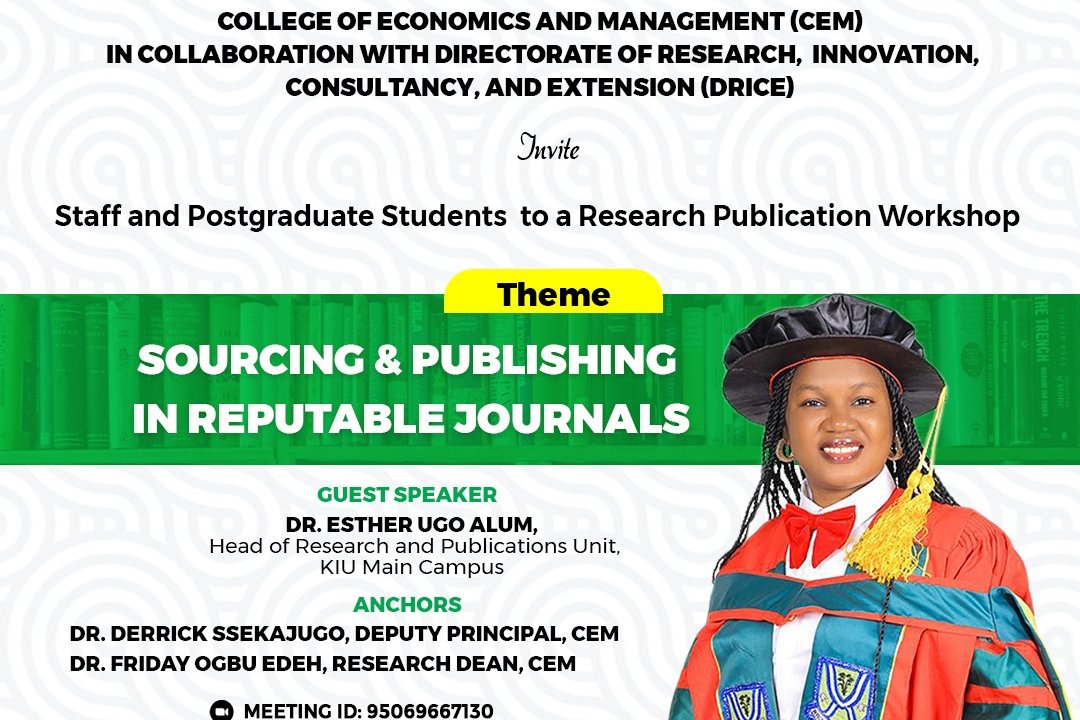
This was the central message conveyed during a Research Publication Workshop organised by Kampala International University (KIU), Main Campus, through the College of Economics and Management (CEM) in collaboration with the Directorate of Research, Innovations, Consultancy and Extensions (DRICE) on Thursday, October 8th, 2026.
Held under the theme, "Sourcing and Publishing in Reputable Journals," the workshop challenged researchers, lecturers, and postgraduate students to become more strategic in their publishing decisions and to prioritise quality over quantity.
The workshop comes at a time when universities worldwide are placing greater emphasis on research visibility, citation impact, and scholarly influence. As researchers face growing pressure to publish high-quality work, understanding how to identify credible publication outlets has become an essential academic skill.
It is against this backdrop that KIU continues to equip its researchers with the knowledge and competencies needed to navigate the dynamic landscape of scholarly publishing.
Facilitating the session, Dr Esther Ugo Alum, Head of the Research and Publications Unit, highlighted the growing importance of understanding journal quality and credibility before submitting a manuscript.
She noted that while many researchers dedicate substantial effort to data collection and analysis, insufficient attention is often given to identifying suitable publication platforms.
"Publishing is not simply about getting a paper accepted," she explained. "It is about ensuring that your research reaches the right audience, contributes to knowledge, and generates meaningful impact."
According to Dr. Alum, reputable journals provide a gateway for research to become visible, discoverable, and useful to scholars, policymakers, practitioners, and development partners across the globe. However, she cautioned that the rapid growth of academic publishing has also created opportunities for predatory and misleading journals that promise quick publication without adhering to rigorous scholarly standards.
To help participants navigate this landscape, the workshop explored major academic indexing databases, including Scopus, Web of Science, Google Scholar, and MEDLINE. Participants learned how indexing systems operate and why they are regarded as important indicators of journal visibility and credibility.
Dr. Alum explained that journals indexed in recognised databases are generally easier to discover, access, and cite, thereby increasing the reach and influence of published research. However, she emphasised that indexing alone should not determine journal choice.
"A reputable journal must not only be indexed but should also align with your research focus, target audience, and disciplinary needs," she noted.
One of the key lessons from the workshop was the importance of verification. Participants were urged to independently confirm journal claims rather than relying solely on information displayed on publishers' websites.
Dr. Alum encouraged researchers to carefully examine a journal's editorial processes, peer-review standards, indexing status, and citation metrics before making publication decisions. She further introduced participants to journal performance indicators such as the SCImago Journal Rank (SJR), which can help researchers assess a journal's scholarly influence and standing within specific academic disciplines.
A significant portion of the discussion focused on manuscript rejection, an experience familiar to many researchers. Dr. Alum explained that manuscripts are often rejected not because they lack valuable ideas, but because of avoidable shortcomings such as weak structure, insufficient evidence, poor reporting of findings, and failure to align submissions with a journal's scope and requirements.
She emphasised that quality research requires quality presentation.
"Even strong research can be overlooked when findings are poorly organised or inadequately communicated," she observed.
Participants were therefore encouraged to pay close attention to manuscript architecture, ensuring that research objectives, methodology, findings, and conclusions are presented clearly, coherently, and persuasively.
Throughout the workshop, discussions extended beyond publication mechanics to the broader role of research in addressing societal challenges. Scholars were reminded that publishing in credible journals increases opportunities for research findings to influence policy, drive innovation, support evidence-based decision-making, and contribute to community development.
As scholarly publishing continues to evolve, researchers are increasingly expected not only to generate new knowledge but also to communicate it effectively. The ability to identify reputable journals, understand publication metrics, and adhere to international publishing standards is becoming as important as the research process itself.
As the session concluded, one message stood out: conducting good research is no longer enough. Researchers must also become discerning publishers, capable of identifying credible journals and communicating their findings effectively to a global audience.
In a world increasingly driven by evidence-based decision-making, the ability to publish in reputable indexed journals is not merely an academic achievement. It is a pathway through which knowledge can influence lives, shape policy, solve problems, and contribute to sustainable development.
In a nutshell, the workshop underscored KIU's commitment to strengthening research excellence and enhancing the visibility of scholarly work produced by its academic community. By equipping researchers with practical skills in journal selection, publication ethics, and manuscript preparation, the University continues to foster a culture of quality research and innovation.
As researchers strive to contribute solutions to local and global challenges, publishing in credible indexed journals remains a critical pathway for amplifying the impact of their work and advancing knowledge for societal transformation.