Your Strategy Needs a Strategy: The Hidden Nuances and Vicissitudes of Successful Strategy
- Agnes Kiconco
- /
- June 23, 2026
- 495

By: Assoc. Professor Chris Ukaidi U.A, Expert in Business Policy and Strategy & Lecturer at KIU College of Economics and Management
In today’s highly competitive and dynamic business environment, strategy plays a critical role in determining both individual success and organizational sustainability. Organizations face numerous challenges, including globalization, rapid technological advancement, economic uncertainty, and evolving customer expectations. A well-crafted strategy enables individuals and institutions to plan effectively, allocate resources efficiently, and achieve long-term objectives.
However, contemporary strategic thinking suggests that merely having a strategy is no longer sufficient. Organizations must move beyond isolated strategic plans and adopt a meta-strategic approach, one that consciously reflects the diversity and complexity of both human and material resources.
Strategy, therefore, becomes the backbone of organizational success. In the absence of competition, the need for strategy would be minimal. Strategy exists precisely because firms seek to gain, as efficiently as possible, a sustainable edge over competitors. A sound business strategy enables an organization to outperform competitors at an acceptable and justifiable cost.
The Three C’s of Strategy
In constructing a business meta-strategy, three key factors must be carefully considered: the Corporation (the business itself), the Customer (the market), and the Competitor (the rivals).
Each of these actors is a dynamic entity with its own interests and objectives. Collectively, they form what is known as the Strategic Triangle, commonly referred to as the Three C’s.
Within the context of this strategic triangle, the role of the strategist is to achieve superior performance relative to competitors across the key success factors of the industry. Sustainable success depends on achieving a positive and enduring match between corporate capabilities and customer expectations.
Competition within the same industry often manifests through reengineered strategies such as price differentiation, branding, repackaging, quality improvement, and aggressive advertising campaigns. Ultimately, an effective (de facto) strategy is one that creates a stronger and more efficient fit between corporate strengths and customer needs, leading to superior value creation and satisfaction.
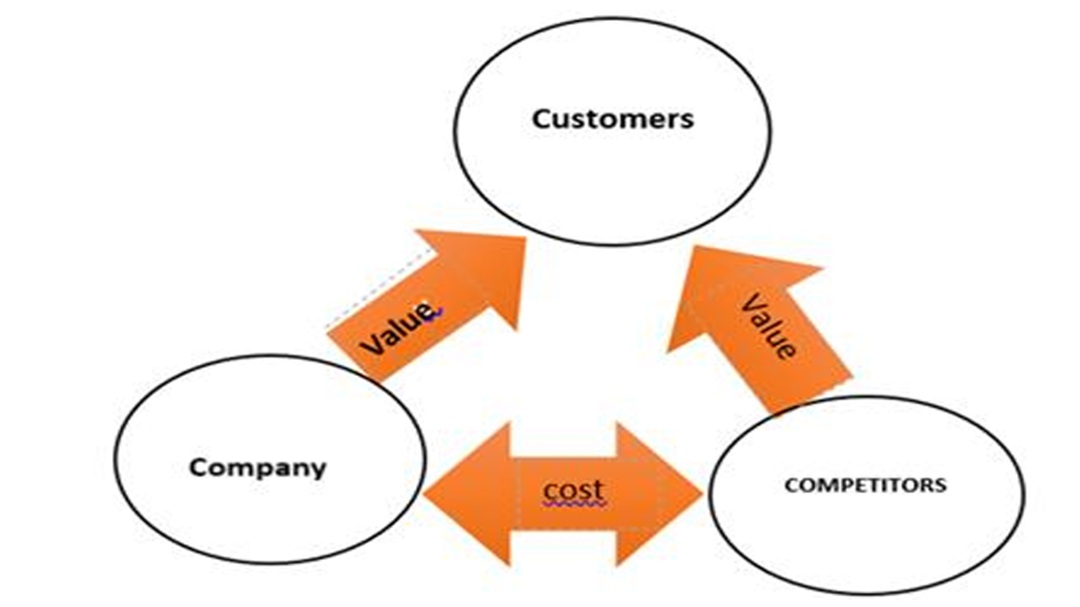
Figure 1: The Strategic Three C’s
From the perspective of the three key players: the corporation, the customer, and the competitor, strategy can be defined as the process by which an organization deliberately differentiates itself from rivals by leveraging its strengths to better satisfy customer needs than the competition.
The Three R’s of Strategic Effectiveness
In addition to the Three C’s, a successful strategy requires sensitivity to three essential conditions, referred to as the Three R’s: Reality, Ripeness (Timing), and Resources.
- Reality
Reality refers to the practical and experiential understanding of the organization’s operating environment. While perception may shape interpretation, sound strategic thinking must be grounded in factual realities and lived experiences. Organizations operate within complex economic, political, technological, cultural, and social systems. Strategy must therefore be anchored in pragmatic analysis and an accurate assessment of the environment. By identifying major trends and integrating them into scenario planning—often referred to as meta-strategy—organizations can anticipate future developments and mitigate emerging threats proactively.
- Ripeness (Timing)
Timing is the second critical consideration for any strategist. Even the most brilliant strategy is likely to fail if implemented at the wrong time. Ripeness refers to the readiness of both the organization and the environment for a particular strategic move.
In today’s highly competitive environment, understanding when to act is just as important as knowing what to do. Effective timing allows organizations to align strategic actions with environmental conditions, gaining advantages such as first-mover benefits, enhanced brand recognition, customer loyalty, and increased market share.
- Resources
Resources form the backbone of any successful strategy. Financial capital, human capabilities, technology, and infrastructure are vehicles through which strategic intentions are converted into tangible outcomes. Without adequate resources, the strategy remains theoretical and unimplemented.
Despite their importance, resource constraints are often overlooked in strategic planning. Numerous strategies have failed because implementation demands exceeded available capabilities. Resources determine not only what is achievable but also the efficiency with which objectives can be realized.
Conclusively, attunement to the Three C’s and the Three R’s is a necessary precondition for creative and effective strategic insight. While no single approach guarantees strategic brilliance, conscious engagement with these dimensions enhances intuition, vision, focus, and execution discipline. When properly aligned and effectively integrated, these elements provide a strong foundation for sustainable strategy and long-term organizational performance.